
Meet the Artist: Elizabeth Castaldo
Elizabeth Castaldo is an artist, printmaker, and bookbinder living and working in Peekskill, NY, and New York City. She works with collage, drawing, and printmaking to create works on paper and artist’s books that explore the connection of feminine sensuality to nature and its manifestations in modern culture. Castaldo received her MFA from SCAD Atlanta where she was a Dean’s Fellow in Printmaking and her BFA from the School of Visual Arts. She has completed residencies at the Center for Book Arts, NYC, and Printmaker’s Open Forum, Oxford PA. Currently, she teaches printmaking and book arts at Parsons School of Design and the Center for Book Arts NYC. Her work is held in many private and institutional collections including SCAD, The University of Alberta, Carnegie Melon University, and Yale University. We were excited to sit down with Castaldo to discuss her art career thus far.
Tell us a bit about your creative journey and how you got to where you are today.
I grew up in a small town in New York, about an hour and a half north of the city. I was a quiet artistic kid and because it was a struggle getting me to go to activities like dance, my mom enrolled me in drawing classes taught by a local artist when I was about 8 years old. I stuck with it until I was 18 and ready to go off to art school. Luckily, my parents were encouraging in my creative pursuits and our public school system actually had a great art program with some wonderful teachers.
I went to college at the School of Visual Arts in New York City, where I had wanted to live since I was a little kid. At SVA my whole world was expanded in such a positive way. My mixed media and collage sensibilities started to form around this time and I fell in love with bookbinding and printmaking.
After a four year break, which included a stint working in the legendary New York Central Art Supply Paper Department as well as trying my hand at being a real estate agent, I decided to go to grad school for printmaking and was accepted to the Savannah College of Art and Design with a Dean’s fellowship, which is a full scholarship.
In addition to learning and honing my skills in a wide array of printmaking techniques, I became fully immersed in making my work of my own, developing my artistic practice and my creative voice. I began learning about feminist theory and applying that to my work, delving into where some of this stuff was coming from within me and I continued exploring materiality and technique as well. I also spent a summer at the SCAD campus in Lacoste, France, a small medieval village in Provence.
I was pregnant towards the end of grad school and after I finished, I immediately moved back to NY and had my daughter. This was a difficult time in which I struggled to make art and figure out my place in the world. It was difficult balancing motherhood with my own needs and others’ expectations.
In 2015, I got a teaching job at a community college and then I was accepted to a residency program at the Center for Book Arts, a community book arts organization in NYC where I had been renting studio time to work on some letterpress and artist book projects. The residency was an amazing boost to my creative practice and connected me more deeply with the book arts community. I also started working in the printshop at Robert Blackburn Printmaking Workshop. Being connected to these two spaces has been incredibly positive, both because of the access to space and equipment and because of the amazing communities and friends I have made.
The residency program at CBA gave me the time and space to create new artist book works and solidify my bookbinding skills. It also launched me more into teaching, as I began teaching at CBA as well as at Parsons soon after my residency ended.
The work I made at CBA was very nature-focused, more so than previous work I had made. The books were about my own relationship with nature and specifically trees. After this residency, I had a short summer residency at Printmakers Open Forum where I made a series of etchings in the ecofeminist vein. I continued working on these afterward and segued this idea into a portfolio I organized for SGCI 2020 called Earth/ Mother, for which 24 printmakers created prints that considered the intersection of women’s and environmental issues.
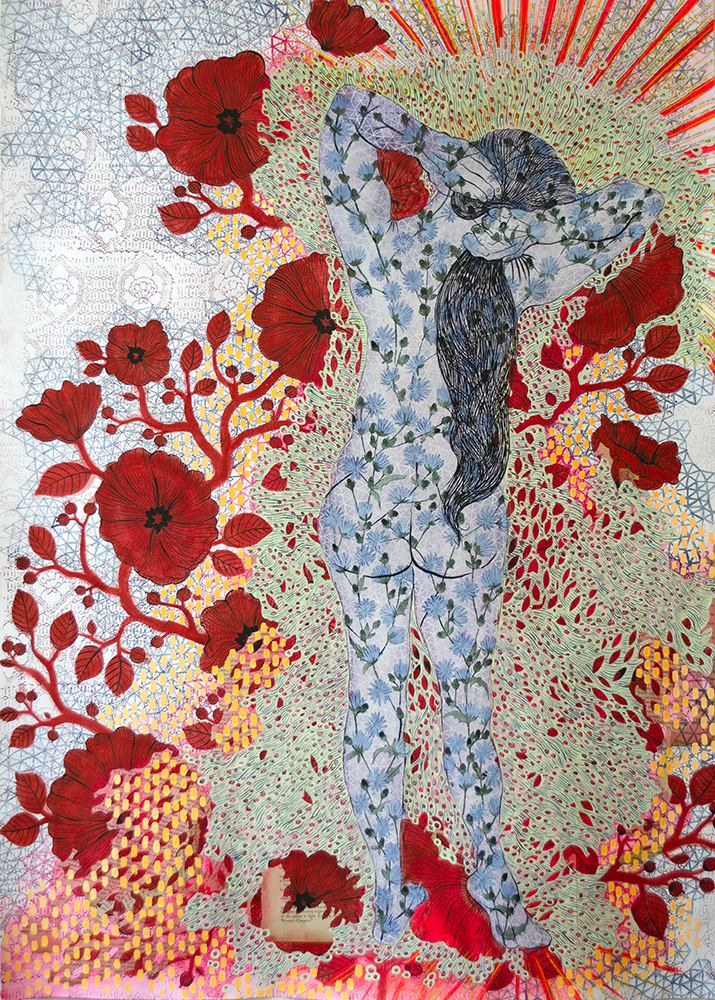
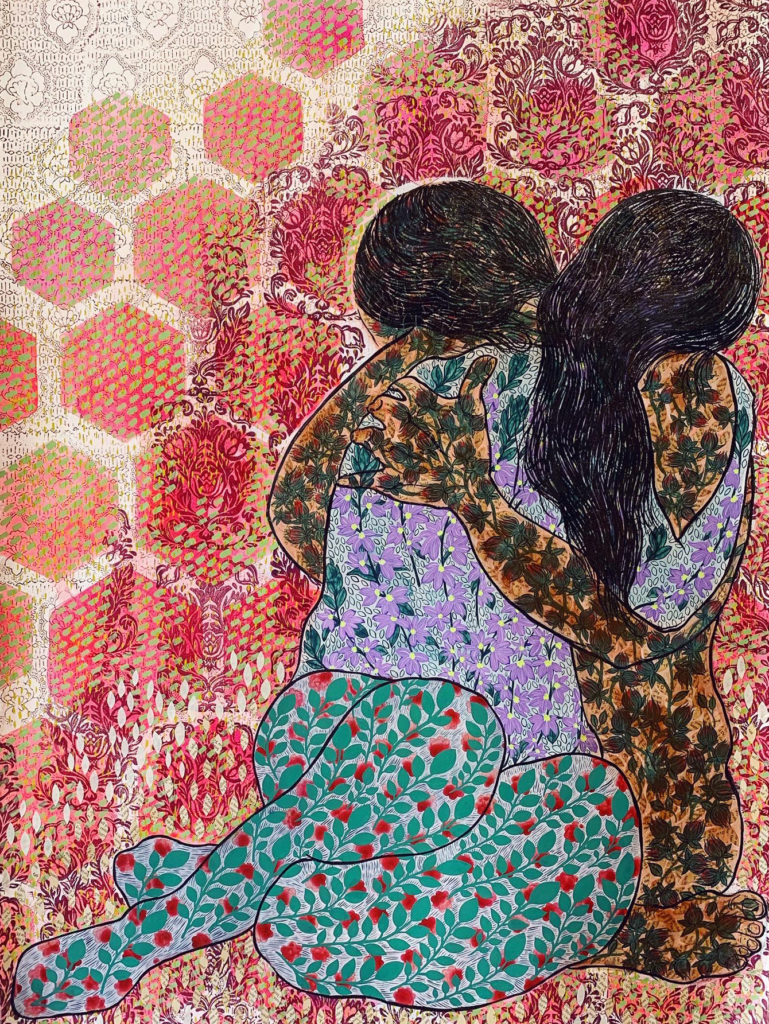
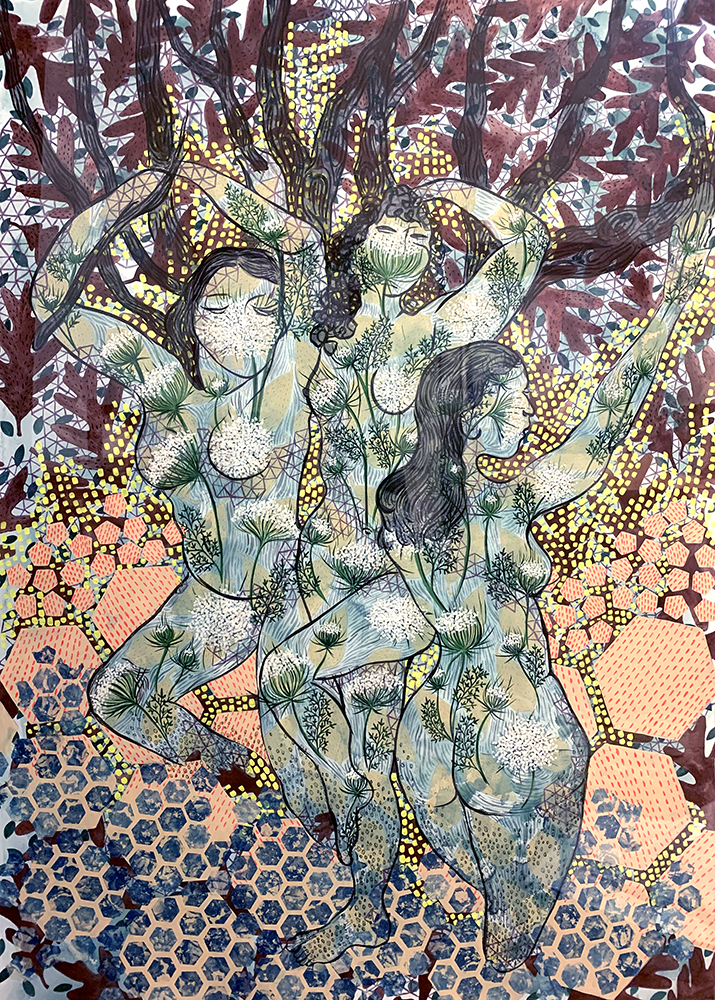
Then the pandemic hit and I was stuck at home, which ended up being kind of a blessing because I was able to fully pour myself into making work and it gave me lots of time to just start experimenting with pattern, layering, and materials. This felt like a recommitment to my studio practice after several years of having to juggle art-making with regular jobs. It was during this time that I developed the work that is included in the Secret Garden exhibition. These started out as experiments with pattern and layering and pushing boundaries between figure and environment. I started working with specific plants as well as more stylized plant patterns. The themes that began coming up were interconnectedness, care, self-care, healing, the connection of the higher self to nature, and the divine feminine. These were very much about my own inner journey and working out some issues that had been present with me for a long time that I was only just beginning to recognize.
All this time I was still working from a tiny room in my house, mostly on a small desk and spreading out to the living room and kitchen table as needed. In June, I finally signed a lease on my very own studio space, my first real studio since I finished school in 2013.
Can you describe the process of creating your work?
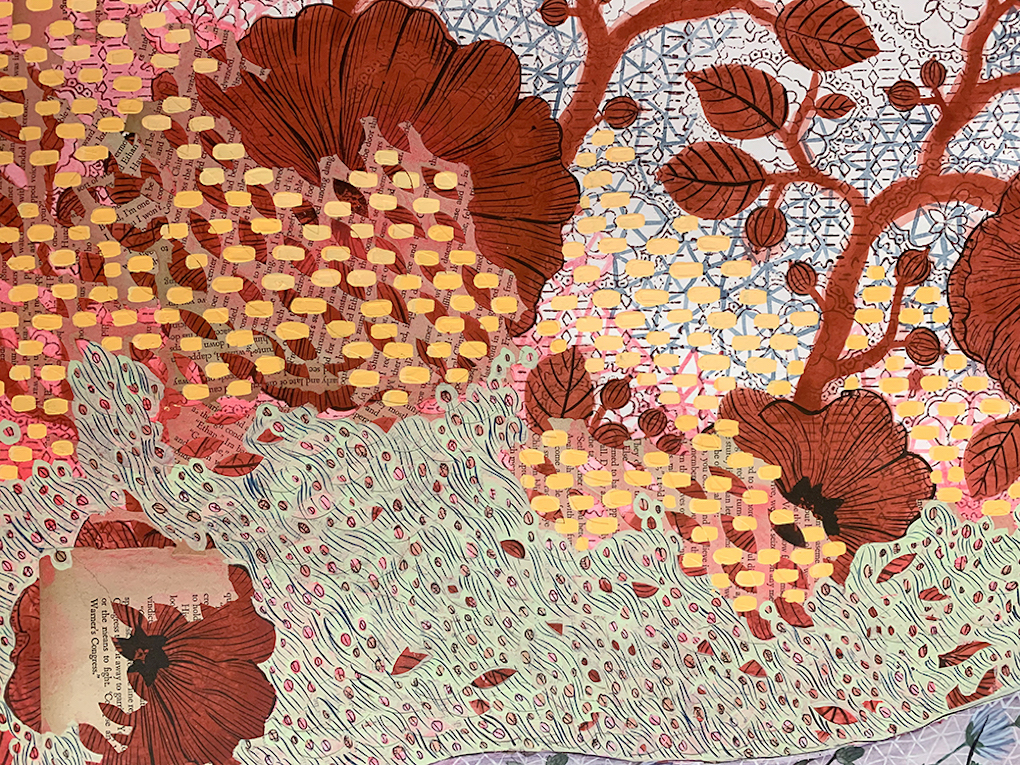
My work is process-driven and reactive, I hardly ever begin with a fully formed idea, just with the seed of an idea, and then go from there, slowly building on that initial spark. Sometimes the work comes out very differently than I thought it would. I commune with the work through the meditative process of creating repetitive hand-drawn and collaged patterns, layering drawing, hand-pulled prints, watercolor washes, and collage as I strive to intertwine figures and environment.
The seed could be a pattern, a color, a feeling, a scene from a movie, the way someone crosses their arms, or a delicate curl of hair. Many of my works have feminine figures in them. Sometimes I work with straightforward poses and other times I manipulate the figures by removing areas or contort them by reassembling pieces to convey the awkwardness of having a body. I made a series of collages like this last year that was really cathartic.
I’ll often start with watercolor washes and then begin building texture with all-over patterns that might end up getting covered later. Then I’ll sketch in the figure and draw any elements that interact with the figure such as plants and flowers. I paint in these elements and layer in collage, stamping or screenprint. I like concealing areas. In my current body of work I’m working towards dissolving the figure into the environment but maintaining the presence of the figure. I use many different media: watercolor, ink, colored pencil, gouache, collage, silkscreen, lithography, rubber stamping, thread, whatever seems right for the piece. All of the different materials that go into the piece contribute to the unique visual language of my work and I enjoy expanding and transforming on these processes and materials.
Do you have a central philosophy in your work that guides you?
Play and experimentation are very important to my practice. In a way, everything I make is an experiment, or that’s how I like to approach it. It’s important to me to remain open to possibilities. I am constantly brought back to this idea that work comes from work. The more work I make the more I learn, the more ideas I get and the more I feel driven to keep going. It’s a very generative way of working.
What inspires you on a day to day basis?
I am inspired by patterns and textures, especially patterns in nature that are mirrored in the body, and the translation of forms from nature into decoration. I love flowers, but even more so leaves and branches. I am inspired by rituals of care, the movement and shape of the body, and the unruliness of long hair. I am a collector and this has always been important to my practice, even before I knew it was part of it. I collect bits of paper to use in collages, interesting stones I find, pretty books, random objects that speak to me, and old photographs of family and strangers. Some of these things are physically used in my work, but many of them serve as a source of inspiration or comfort.
Briefly describe the role of text in your drawings.
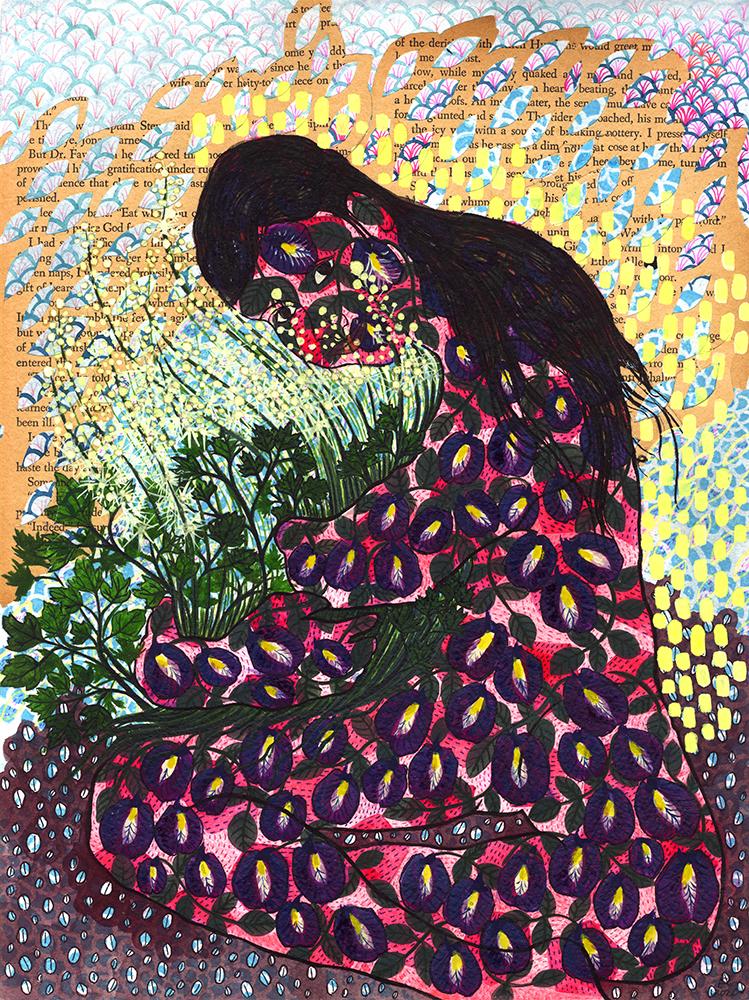
I love using text to create texture and patterns. Sometimes I think of it as words unspoken or the whispers of the wind. Occasionally I’ll find a book that feels significant to me because of the subject matter and I’ll use a few strategically placed words in a piece but most of the time this text can come from any type of found book, always books that are falling apart and would be trashed anyway.
Many of your works have strong links between nature and femininity. Can you explain why this is a recurring theme in your works and what it means to you?
In my current body of work, I am working with the idea of the divine feminine, an inner power of creativity and sexuality independent from the desire of others with a strong connection to nature, that I seek to recognize within myself while reconciling it with the pressure put on me as a woman and a mother living within a patriarchal society.
Nature motifs have been running through my work probably for as long as I’ve been making art, as have themes of femininity, and those two things have become closer and closer as I continue. I consider the connections of feminine sensuality to nature both in a classical sense, such as in Greek mythology, and how this manifests in our contemporary culture. We have seen the degradation of the environment being bound up with the exploitation, oppression, and violence against women for centuries. This ranges from the violence inflicted by colonialism to women water protectors and land defenders trying to protect their homelands from the interests of resource extraction to the limitation of women’s access to reproductive healthcare and so much more.
Culturally we often think about femininity as soft but there is also a fierceness there that I think comes from women often having to push back against patriarchy and be the caregivers and protectors of both people and land. Women are often the leaders of movements for social and environmental justice.
Humans are part of nature and when we harm nature we do so much harm to ourselves. I am often thinking about what it feels like to be in a female body, what is my body, what are the boundaries of my body, and at what point does my body end and my surroundings begin? Are there ways that I can connect with nature no matter where I happen to be?
During 2020, themes of interconnectedness began manifesting in my work and I began to think about the ways we are held together when we can’t be physically together. How can one subvert cultural limitations and center love, care, and sustainability, rather than hierarchies of dominance, as a way to care for self, others, and the earth? How can we tap into holistic ways of healing from the harms of an extractive society?
What do you think of the media’s role in society?
I think at its most basic, media often reflects ourselves back to us. Much of the media is trying to sell us something. Something mildly popular will be latched onto, turned into a trend and pushed back at us until we are sick of it and lose interest and the cycle starts again. Even so much of what we might call journalism has unfortunately devolved into entertainment disguised as news. If you are looking for facts or even just something true and genuine you really do need to do quite a bit of research to find those sources.
At the same time, the media connects us to things happening outside of our bubbles and allows us to share the enjoyment of films, books, and art that may come from countries and cultures far away from our own homes. So even as frustrating as the media can be at times, I think it also makes for a richer, more informed, and more enjoyable shared human existence.
Is there a work you’ve created that you are particularly attached to? If so, why?
I’m often attached to whatever happens to be my most recent work, right now it’s my painting, “The First Step” and a tiny artist’s book called “Putting My Face On.” Once it’s time though, I am always happy to see my work end up in someone else’s space where they will enjoy it every day.
Do you ever collaborate with other artists?
I haven’t really collaborated with other artists to create individual works of art together. However, earlier this year I had the opportunity to collaborate on a small project through an online program with Proyecto ‘Ace based in Argentina. Luis Sahagun, Susanna Crum, and I created an ephemeral video and sound work that exploited some of the video and audio idiosyncrasies of Zoom to do a live performance during one of the sessions. I use ephemeral as a nice way to say we, unfortunately, did not get a good recording of the performance. The collaboration was a great experience. We each pulled from our skill sets and studio practices to create something really unique together that I don’t think any of us would have made on our own.
Name some artists who inspire you.
Louise Bourgeois, Agnes Martin, Swoon, Nancy Spero, Frida Kahlo, Yayoi Kusama, Fierli Baez, Saya Woolfalk, Lina Puerta and many more.
What are some books you return to?
My recent literary obsessions:
bell hooks All About Love
Audre Lorde Uses of the Erotic/ Sister Outsider
Jeff Vandermeer Southern Reach Trilogy
Robin Wall Kimmerer Braiding Sweetgrass
Peter Wohlebean The Hidden Life of Trees
The Heart podcast