



“I start from something considered dead and arrive at a world. And when I put a title on it, it becomes even more alive.”
Joan Miro
No matter what the medium, style, or subject matter, the one thing that all artworks have in common is that they all have a title. An artist might name their artwork titles after a feeling, a place, or an inspiration, but they may also resort to the most commonly seen title of all, “Untitled.” What makes artwork titles important, why are they necessary, and how can an artist create one that stands out? We’re taking a close look at artwork titles to better understand why they’re important.
Organization
Let’s start with the obvious and most mundane reason why it’s beneficial to have a title for each artwork: organization. Simply put, from a gallery, museum, or collector’s viewpoint, titles make categorizing works easier. Can you imagine what a museum’s database of works would look like if instead of titles, there were descriptions of every work in their inventory? As the descriptions of artwork are almost entirely subjective, it would be really hard to have any sort of organization without assigning each work a number. It would also be really difficult to go about marketing art without titles because you have to call them something to differentiate between works.
Contextualize the Work
When a viewer sees a work for the first time, they will inherently draw conclusions about it by pulling from their own personal experiences. It might make them feel happy, sad, excited, confused, or any number of other emotional responses. The artwork might bring back old memories or pose a question for the viewer to ponder. To help the viewer decipher what the work is about, the artist often leaves a clue in the title.
A title is like a frame to set the context of the work, giving viewers a bit of information that might not be immediately clear from looking at the work. Of course, the title can also throw the viewer off — they might be thinking one thing and then realize by the title that their interpretation is completely different from the artist’s. An artwork title can 100% change the way you experience the work, which is why it’s important that artists give some thought to naming their works.
Show the Personality of the Artist
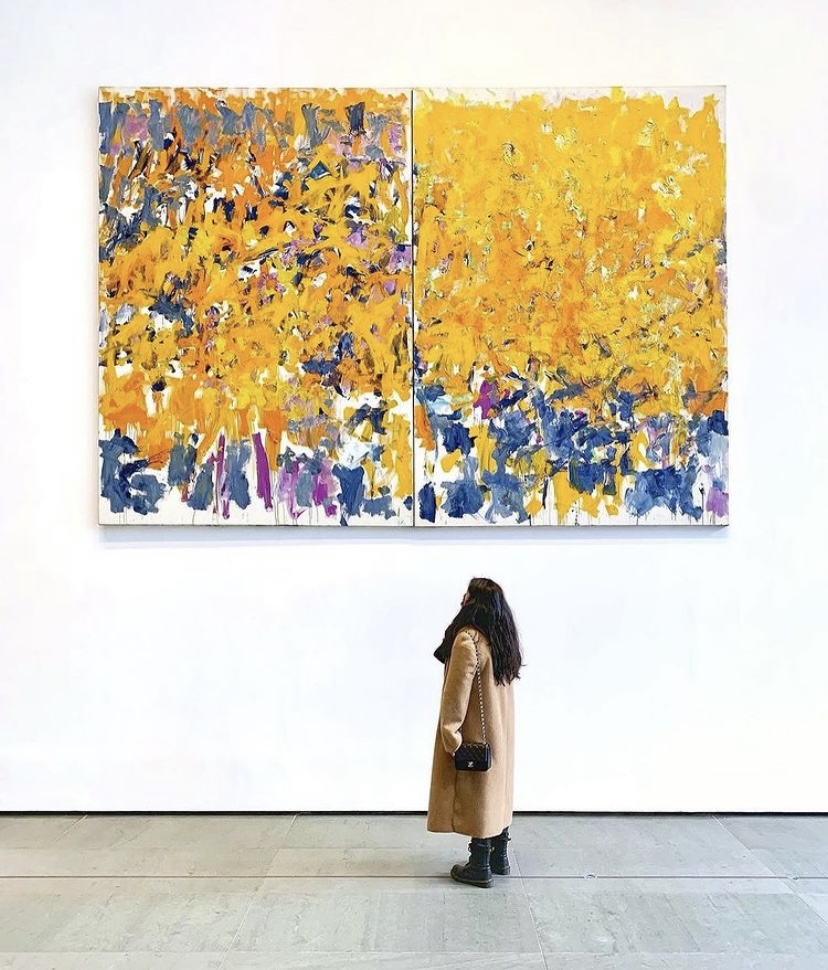
Joan Mitchell – Wood, Wind, No Tuba, 1980. Oil on canvas, two panels. 9′ 2 1/4″ x 13 1 1/8″ (280 x 399.8 cm). Gift of The Estate of Joan Mitchell. MoMA Collection. Photo from @themuseumofmodernart Instagram
Part of the joy of buying a work of art is supporting the artist, a real person with a talent you believe in. By titling a work or a collection of works, the artist can show a bit of themselves and their personality. The collector is buying into not just the artwork, but the artist, who is also their own brand in the context of art sales. Take the photo above for example, which shows Joan Mitchell’s work, “Wood, Wind, No Tuba.” The lighthearted title pairs perfectly with the work and in my mind, makes it even more appealing as you get that punch of humor (she’s referring to the inspiration of nature, but uses a pun with instruments) along with the beauty of the work. This title not only gives you a bit of context, letting you know that the abstraction is based on the outdoors, but the witticism humanizes the work and makes it even more fun.
In Defense of “Untitled”
“As before, the pictures are to be without titles of any kind. I want no allusions to interfere with or assist the spectator.”
Clyfford Still
Artists who name their works “Untitled” often choose this route because they want their work to speak for itself and not have a title muddy the meaning. If the artist feels like the title is interfering with their intent, they might make the choice of using “Untitled” so that the viewer can make their own assessment of the work without that extra bit of information. As the role of abstract art is often to evoke a feeling or see what the viewer can interpret from the colors or shapes, an artist might feel that a title takes away from that personal experience. It’s difficult to create a title that doesn’t at least suggest a narrative.
Popular Methods of Creating Titles
- Name a work after a poem, song, or song lyric, as LCA artist Joan Aglaia does with her works.
- Name a work after what it represents (a scarf, an apple, a person’s name, etc.)
- Add a bit of humor
- Use an evocative verb like burn, bury, expand, flinch, immerse, unravel
- Grab a thesaurus and search exciting synonyms for common words
- Ask a friend what they see in the work
- Name it after an idiom like “blessing in disguise,” “bite the bullet,” “benefit of the doubt”
Artwork titles are never the be-all and end-all of an artwork’s meaning. While they may suggest one way of viewing a work, by seeing that as the only way, you are limiting your view. A title can be a helpful tool, but don’t let it keep you from thinking critically. It’s always a good idea to view the work first before looking at the title, just as we suggest viewing a work before reading an informational wall plaque at a museum.
What do you think of titles? Leave a comment below letting us know how you create titles if you’re an artist or what types of titles you’re attracted to as a viewer/collector.